
MumbaiWood 2026 and India Market Visit
September 2026
NZTIF recently participated in MumbaiWood 2026 in Mumbai as part of a wider programme aimed at developing opportunities for New Zealand timber products in India.
NZTIF President Bruce Larsen and Chief Executive Jeff Ilott travelled to India from 14 to 21 September, with the visit supported by NZ Trade and Enterprise, Te Uru Rākau and the Bio-Economy Science Institute. The programme was designed to combine the trade show with direct engagement across the Indian timber, construction, design and manufacturing sectors.
MumbaiWood and the New Zealand presence
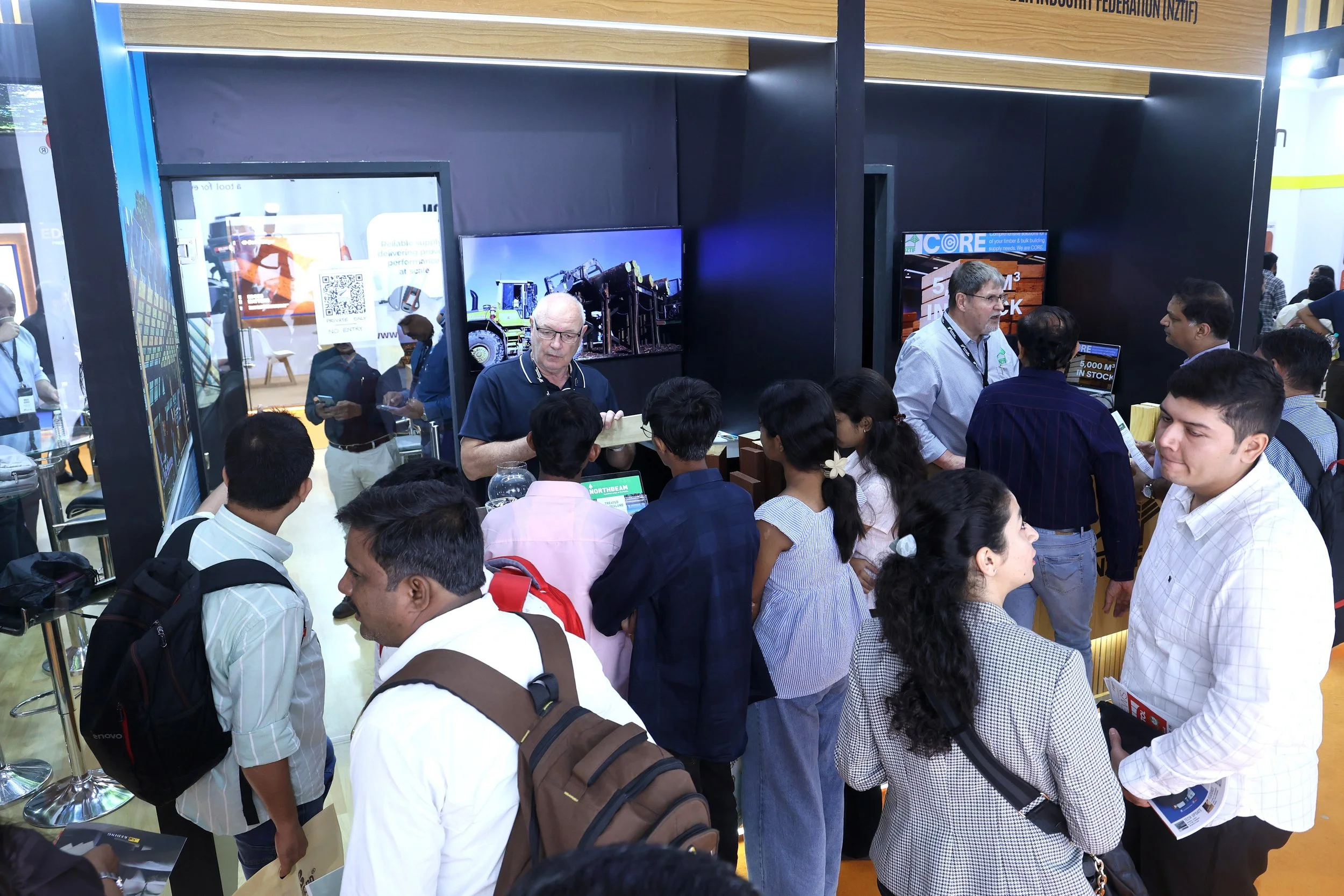
MumbaiWood 2026 was held at the Bombay Exhibition Centre from 18 to 20 September 2026. NZTIF participated through the New Zealand Pavilion, which was organised with NZTE support.
The Pavilion initiative was intended to give New Zealand wood and forestry organisations individual visibility while also presenting a coordinated New Zealand presence. The programme was designed around engagement with manufacturers, importers, distributors, architects and project buyers.
NZTIF took a range of physical New Zealand radiata pine product samples to Mumbai, including decking, weatherboards, structural timber, clears, LVL and Glulam, enabling discussions to move beyond logs and commodity products and demonstrate the range of value-added products New Zealand can supply.
Why India matters
The visit was deliberately broader than attending a trade show.
Before departure, NZTIF identified four objectives:
promote New Zealand radiata pine and its performance, sustainability and supply credentials;
develop relationships with organisations capable of supporting greater market access and timber utilisation;
improve our understanding of Indian demand, regulation and barriers to entry; and
identify opportunities for greater specification and use of New Zealand timber across construction, manufacturing, packaging and related applications
The market work supporting the visit highlights an important distinction for New Zealand exporters. New Zealand already has an established position supplying softwood logs to India, but its presence in value-added products, ranging from sawn timber through to cladding, decking and engineered wood, remains limited. A market study circulated to the travelling group identified premium construction, commercial and hospitality applications among areas where further opportunities may develop. The market study will be circulated once finalised.
This reinforces NZTIF's view that the opportunity is not simply to sell more wood into India. The longer-term challenge is to build recognition of New Zealand radiata pine as a reliable material for a much broader range of higher-value applications.
Building relationships beyond the trade show
A central purpose of the visit was therefore relationship-building.
Prior to departure, NZTIF had identified engagement with organisations including the Indian Institute of Architects, Indian Institute of Interior Designers, Indian Society of Landscape Architects, Builders Association of India and the Association of Furniture Manufacturers and Traders as part of the programme.
This approach reflects an important lesson from the work undertaken before MumbaiWood: India needs to be approached through both the commercial supply chain and the organisations and professionals influencing material choice.
NZTIF's earlier discussions concerning the Association of Furniture Manufacturers and Traders, for example, identified the organisation as potentially useful for industry connections, knowledge exchange and understanding market dynamics, while recognising that relationships with larger manufacturers, processors, importers and distributors would also be necessary to generate commercial opportunities at scale. We are presently working towards having Memorandum of Understanding finalised with the Association of Furniture Manufacturers and Traders covering education, market access and potentially a visit from a delegation representing their 350 members.
Immediate commercial leads
Importantly, there has already been tangible follow-up from the visit.
Following a meeting in Mumbai a number of Companies are seeking introductions to member companies exporting sawn timber. The contacts have expressed an intention to identify potential New Zealand supply partners and, if suitable partners are identified, to visit New Zealand.
The enquiries include interest in sawn timber and specifically asks NZTIF to facilitate contact with member exporters to explore the potential for longer-term cooperation.
This is the type of outcome NZTIF hoped the Mumbai programme would encourage: moving from general market awareness to direct conversations between Indian buyers and New Zealand suppliers. One thing quickly became evident through the visit is that there will be a need to establish relationships with Distributors within India. Many of the individuals we talked with are interested in sawn Timber from NZ, but the size of their operation means they do not necessarily have the scale to be importing full containers themselves, but the sheer volume of Operations in India may well make this a viable option.
Treated timber and higher-value applications
The visit also supported NZTIF's interest in exploring applications beyond conventional commodity markets.
Work undertaken before MumbaiWood examined the Indian position on treated pine for applications such as decking, boardwalks, pergolas, landscaping and other exterior uses. Information provided through NZTE indicated that CCA-treated pine is technically suitable for a range of outdoor applications, subject to appropriate treatment standards and project requirements, although customer preferences can vary, particularly in premium residential and hospitality projects.
Historically, Radiata has been seen as low grade, and it is often in poor condition when it hits the market in India following transportation in log form and processing in India. People were generally surprised at the quality of Pine available and its range of potential uses.
That points to potential areas for New Zealand companies supplying treated timber and other value-added products, but it also reinforces the importance of working with architects, engineers, developers and customers so that specifications and treatment systems are appropriate for each project.
What we learned
The visit reinforces several themes for NZTIF.
India should be viewed as a relationship market. Commercial opportunities are more likely to develop through sustained engagement with importers, manufacturers, designers, specifiers and industry organisations than through a one-off trade show presence.
Value-added products deserve greater attention. New Zealand's existing position in logs provides familiarity with radiata pine, but does not automatically create a market for higher-value sawn, treated or engineered products.
Technical information matters. Treatment, durability, engineering properties, product standards and evidence of successful end-use applications will be important parts of the value proposition, particularly when engaging architects, engineers and project developers.
Following up leads will be critical. The enquiries already received demonstrate that the value of MumbaiWood will ultimately be measured by what happens after the event, not simply by activity at the Pavilion.
What happens next
NZTIF's priority is now to turn the relationships and intelligence generated through the visit into practical opportunities for members.
This includes facilitating appropriate introductions between interested Indian organisations and New Zealand suppliers, continuing engagement with relevant Indian industry organisations, and sharing useful market intelligence with members.
For companies considering India, our message following Mumbai is positive but pragmatic: there are opportunities, but establishing a durable New Zealand position will require persistence, market knowledge, appropriate products and strong local relationships.
MumbaiWood was therefore not an end point. It was another important step towards building a more coordinated New Zealand timber presence in India.
NZTIF will continue to work with its New Zealand partners and Indian contacts to identify where opportunities are commercially realistic and where collective industry activity can help individual members enter or develop the market.
In summary
The Mumbai programme has provided NZTIF with stronger market connections, direct exposure for New Zealand radiata pine and an initial post-visit commercial enquiry. The next phase is about converting those connections into practical pathways for NZTIF members while continuing to build India's understanding of the breadth of products and capabilities available from New Zealand.